
INSTITUTIONAL CONTINUITY, SYSTEMIC FORBEARANCE, WHISTLEBLOWER RETALIATION, AND REGULATORY CAPTURE (2000–2026)
2nd November 2026
Executive Synthesis: The Illusion of the 2013 Structural Break
The dissolution of the Financial Services Authority (FSA) and its replacement by the Financial Conduct Authority (FCA) and the Prudential Regulation Authority (PRA) on 1 April 2013 under the Financial Services Act 2012 was presented to Parliament and the British public as a decisive architectural break from the “light- touch” regulatory orthodoxy that precipitated the 2008 global financial crisis1.
However, an exhaustive synthesis of statutory inquiries, judicial rebukes, parliamentary investigations, internal audit disclosures, and testimonies from over 174 whistleblowers, victims, and former regulatory staff establishes that the 2013 transition was largely a cosmetic rebranding exercise1. Beneath the statutory renaming, the regulator’s personnel, institutional network, organisational design, and defensive mentality remained fundamentally unaltered1. Testimony from former FCA supervisors confirms that the authority’s internal hierarchy and decision-making ethos remain dominated by “FSA-era ‘deep-state’ actors” embedded within its Senior Management and Senior Leadership Teams1.
Across more than two decades of operation, the conduct of the FSA and the FCA has exhibited a consistent structural pathology: systemic forbearance toward major clearing banks and large financial institutions, contrasted with aggressive procedural attrition against whistleblowers, small independent financial advisers (IFAs), and retail or small-and-medium enterprise (SME) complainants1. Rather than functioning as an impartial public-interest policeman, the regulator has operated within a conflicted statutory and economic architecture in which preserving the capital adequacy of systemically important banks, protecting the equity value of HM Treasury shareholdings, and promoting the international competitiveness of the City of London routinely supersede consumer protection and market integrity2.
When catastrophic supervisory failures occur, the institution deploys a standardised defensive playbook characterised by statutory secrecy under Section 348 of the Financial Services and Markets Act 2000 (FSMA), asymmetric “Maxwellisation” of independent reviews, the delegation of forensic investigations to the accused institutions themselves, and the active exposure or career destruction of whistleblowers who challenge the official narrative1.
The 2008 Banking Crisis, the HBOS Insolvency, and Post-Crisis SME Asset-Stripping Pre-2008 Prudential Blindness, the £48 Billion HBOS Hole, and Audit Collusion
In the years preceding the 2008 banking crash, the FSA presided over catastrophic prudential and conduct failures across the United Kingdom’s largest financial institutions, most notably Northern Rock, Royal Bank
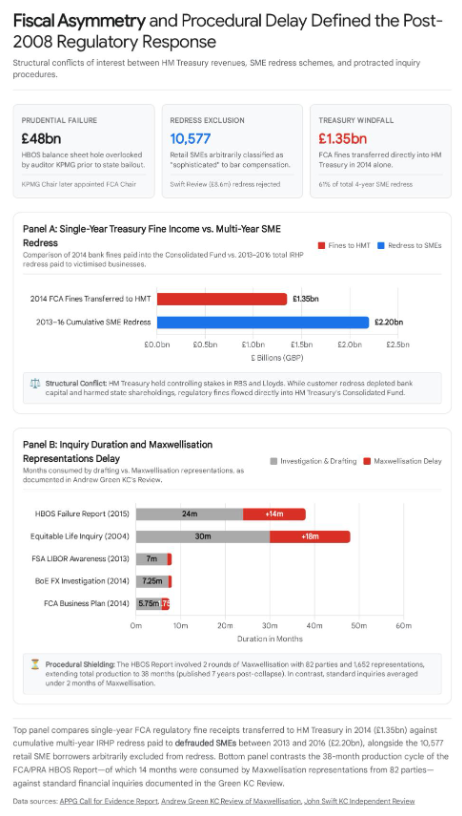
of Scotland (RBS), and Halifax Bank of Scotland (HBOS)1. At HBOS—then the largest mortgage lender and bank on the UK Stock Exchange—supervisory blindness masked deep-seated balance sheet insolvency1. Forensic findings compiled by Anthony Stansfeld, then Police and Crime Commissioner (PCC) for Thames Valley Police and Portfolio Lead on Fraud for the Association of Police and Crime Commissioners, alongside the whistleblower record of financial engineer Iain Clifford, indicate that HBOS carried an undisclosed balance sheet hole of between £40 billion and £48 billion, rendering the bank technically insolvent from at least 2005 prior to its state-engineered rescue takeover by Lloyds TSB in 2008–2009 and a £20.5 billion taxpayer bailout1.
Rather than holding the bank’s executives or its statutory auditor, KPMG, accountable for overlooking tens of billions of pounds in balance sheet deficiencies, the regulatory apparatus closed ranks through the revolving door1. Four months after internal whistleblower evidence regarding the HBOS cover- up (the Project Lord Turnbull Report) was delivered to the executive board of Lloyds Banking Group, John Griffith-Jones—who had served for six years until 2012 as Chairman and Senior Partner of KPMG, the very firm that signed off HBOS’s clean audit opinions—was appointed as the inaugural Non-Executive Chairman of the newly formed FCA in 20131.
Concurrently, the Chairman of the Financial Reporting Council (FRC), which oversaw the granting of a “clean bill of health” to KPMG’s audits of HBOS, was a former Chairman of Lloyds, while former FSA Chairman Sir Howard Davies revolved into the chairmanship of state-rescued RBS in 20151.
State-Directed Balance Sheet Repair and the Fines-Versus-Redress Conflict
Following the 2008 banking bailouts, the operational priority of HM Treasury and the financial regulators shifted from policing bank misconduct to repairing depleted bank balance sheets at the expense of commercial borrowers1. HM Treasury established UK Financial Investments Limited (UKFI) and the Asset Protection Agency Limited (APA) to manage the state’s controlling shareholdings in RBS/NatWest Group and its major stake in Lloyds Banking Group (LBG)1. Accounting notes for UKFI and the APA indicated that these state entities “materially influenced” the rescued banks, incentivising aggressive restructuring and the systemic asset-stripping of viable SME customers to recapitalise bank balance sheets1.
Throughout this post-crisis period, the FSA and FCA stood down from enforcing their Conduct of Business Sourcebook (COBS) and overarching Principles for Businesses—specifically Principle 6 (“A firm must pay due regard to the interests of its customers and treat them fairly”)—against the major clearing banks1. This supervisory abdication was reinforced by an acute fiscal conflict of interest between the FCA and HM Treasury1. Because HM Treasury was the majority shareholder in RBS/NatWest and a substantial shareholder in LBG, compelling those banking groups to pay tens of billions of pounds in full consequential redress to defrauded SMEs would have transferred capital directly out of bank shareholder funds, depressing bank profitability and damaging the value of the government’s equity holdings4.
Conversely, when the FCA imposed regulatory fines on banks for wholesale market misconduct—such as LIBOR or foreign exchange (FX) rigging—rather than ordering customer restitution, the fine proceeds flowed directly into HM Treasury’s Consolidated Fund1. In 2014 alone, HM Treasury received approximately £1.35 billion from the FCA in bank fines, whereas SMEs across the United Kingdom who suffered tens of billions of pounds in direct and
consequential losses from the Interest Rate Hedging Product (IRHP) and fixed-rate loan mis-selling scandals received a cumulative total of only £2.2 billion between 2013 and 20161.
The Interest Rate Hedging Products (IRHP) Cover-Up and the Swift KC Review
Between 2001 and 2012, UK banks systematically mis-sold complex interest rate derivatives—including swaps, caps, and structured collars—to tens of thousands of retail SMEs as a precondition for commercial loans1. These instruments frequently embedded undisclosed contingent liabilities, exorbitant exit penalties, and hidden margin credit lines into loan facilities at a time when institutions such as Bank of Scotland were trading insolvently1.
As established in John Swift KC’s December 2021 Independent Review into the Supervisory Intervention on Interest Rate Hedging Products—an inquiry that cost £8.6 million—the FSA and FCA repeatedly shied away from exercising their statutory powers under Sections 382 and 384 of FSMA 2000 to impose a mandatory restitution order1. Each time formal enforcement came up for consideration, the regulator decided not to institute enforcement proceedings against any bank or individual executive, leaving the authority without a viable fallback option when negotiating with the banks1.
Bowing to intense pressure from HM Treasury ministers and officials to cap the banks’ financial liability, the FSA agreed to a voluntary redress scheme in 2012 that arbitrarily tightened the “sophistication” criteria1. Through this administrative manipulation, 10,577 retail SME borrowers were retroactively reclassified as “sophisticated” investors and summarily excluded from redress1. Even after Swift KC concluded that the voluntary scheme was an inadequate regulatory response and recommended redress for the excluded businesses, the FCA rejected its own independent reviewer’s recommendation and refused to compel the banks to compensate the excluded victims1.
Systemic Banking Frauds: RBS GRG, HBOS Reading, and Ulster Bank RBS Global Restructuring Group (GRG) and Forensic File Falsification
Following the 2008 crash, RBS transferred over 12,000 viable SMEs into its turnaround division, the Global Restructuring Group (GRG), where business properties and assets were artificially devalued, loaded with punitive fees, defaulted, and stripped via RBS’s property subsidiary, West Register1. Beyond the structural asset-stripping, whistleblowers and victim advocacy groups uncovered systemic document forgery by the bank1. In September 2015, the SME Alliance presented Karina McTeague, then FCA Head of Banking Supervision, with eight forensic case studies demonstrating that RBS/NatWest had systematically forged customer records, altered internal emails, and made more than 1,000 material alterations to telephone call transcripts in order to deceive the courts and the Financial Ombudsman Service (FOS)1. McTeague refused to examine the forensic files, asserting the false pretext that the FCA does not investigate crime1. Worse still, within days of receiving the SME Alliance’s confidential whistleblowing dossier on RBS file forgeries, the FCA leaked the dossier directly back to RBS/NatWest and exposed a bank whistleblower who had been assisting SME victim Clive May1. The FCA subsequently aborted Phase 2 of the Section 166 Skilled Persons forensic investigation into GRG—sparing RBS millions of pounds in compensation—and sided with RBS in
excluding victims from remediation even where internal FCA file notes confirmed the businesses had been managed within GRG1.
The HBOS Reading (£1 Billion) Fraud, the Cranston Review, and the Dobbs Review Delay
Between 2002 and 2007, Lynden Scourfield, Director of the HBOS Impaired Assets Reading (IAR) unit, and Associate Director Mark Dobson conspired with turnaround consultancy Quayside Corporate Services (QCS), controlled by David Mills and Michael Bancroft1. In exchange for cash bribes, luxury foreign holidays, high-end watches, and illicit personal inducements, Scourfield forced distressed SME customers of HBOS to engage QCS, pay millions of pounds in consultancy fees, and take on unserviceable debt facilities before stripping or liquidating their businesses1. Although internal HBOS investigators identified serious irregularities at Reading in a May 2007 report, Bank of Scotland failed to disclose the fraud to the FSA until July 20091. A Section 166 Skilled Person report dated 9 July 2010 confirmed that HBOS’s internal inquiry lacked coordination, took no disciplinary action against Scourfield or Dobson, and identified at least £3.9 million (and potentially another £4.1 million) paid to QCS from a small sample of files8. Despite passing the Skilled Person report to Thames Valley Police in July and September 2010, the FSA and FCA took no regulatory enforcement action for a decade—finally levying a £45.5 million fine against Bank of Scotland in June 2019—and took no steps during the intervening ten years to halt Lloyds Banking Group from pursuing legal repossessions and bankruptcies against the defrauded victims1. Following the 2017 criminal conviction of Scourfield, Dobson, Mills, Bancroft, and their co-conspirators, LBG established the Griggs Customer Review in March 2017, overseen by Professor Russel Griggs OBE with the explicit endorsement of the FCA1. After widespread outcry from victims and parliamentarians, Sir Ross Cranston (former Solicitor General and High Court judge) was appointed in March 2019 to conduct an independent Assurance Review8. Published on 10 December 2019, the Cranston Review exposed profound structural and procedural unfairness across the FCA-approved Griggs scheme1:
| Dimension of the Griggs Scheme | Public Representation by LBG & FCA | Actual Operational Reality Exposed by Sir Ross Cranston (Dec 2019 & Subsequent Clarifications) |
| Direct & Consequential (D&C) Loss Awards | Anticipated £100m compensation pot covering economic losses, distress, and inconvenience. 8 | LBG paid zero awards (£0) for D&C loss across all 71 businesses and 191 directors, treating the bank as the sole financial victim of its own managers’ fraud and implying every customer business would have failed anyway. 1 |
| Evidential Threshold & Disclosure | A non-legal, customer- focused review where legal representation was unnecessary and discouraged. 1 | LBG secretly applied an adversarial legal standard stricter than civil litigation, demanding contemporaneous proof while enforcing a blanket refusal to disclose bank files or fund forensic accountants for victims. 1 |
| Secret Forensic Rebuttals (EY Reports) | Transparent, collaborative assessment of customer losses overseen by an independent reviewer. 8 | LBG secretly commissioned accounting firm EY to produce forensic reports on 8 complex cases to rebut D&C claims, concealing those EY reports from victims, from Professor Griggs, and initially from Sir Ross Cranston. 1 |
| Reclassification of Economic Losses | Distinct assessment of economic D&C losses versus non-legal Distress & Inconvenience (D&I). 8 | Where Professor Griggs identified valid D&C financial losses, LBG pressured him to reclassify those sums as discretionary “uplifts” to D&I payments to avoid recording any D&C liability on the bank’s books. 1 |
| Settlement Agreements & Gagging Clauses | Supplied a benign “sample” settlement template (Version 1, used for only 18 customers) to the Treasury Select Committee. 1 | Forced the vast majority of victims (and non- director shareholders receiving over £2,000 in refunded QCS fees) to sign undisclosed templates (Versions 2–4) with draconian release and “non- assistance” clauses (Clauses 2.2 and 2.3) barring co-directors from sharing evidence. 1 |
| Procedural Independence of Reviewer | Professor Griggs presented as an independent “SME champion” reviewing and approving outcomes. 8 | Griggs operated from an @lloydsbanking.com email address, had his outcome letters dispatched by the bank, and refused to disclose his own advisers’ (Taylor Wessing and RSM) working papers to Cranston on grounds of privilege. 8 |
| Debt Relief & De Facto Directors | Promise to write off all remaining relevant business and personal debts of fraud victims. 8 | Discriminated against victims who had already repaid debts via asset liquidation, refinanced with other lenders, or suffered repossession, and excluded spouses/partners and sole traders/partnerships until Cranston’s Clarification Report forced retrospective parity and an independent appeals process under Rory Phillips KC . 10 |
Even more egregious is the ongoing suppression of accountability regarding the corporate cover-up of the Reading fraud. On 9 January 2014, Sally Masterton, a senior accountant in LBG’s Commercial Banking (Risk) division, authored the internal “Project Lord Turnbull” report following her July 2013 interviews with Thames Valley Police1. The report documented that HBOS and LBG intentionally concealed the Reading fraud and artificially reduced a £1 billion fraud provision to £200 million in 2007 to mislead shareholders, auditors, regulators, and Lloyds TSB ahead of the 2009 acquisition1.
Rather than protecting Masterton, the FCA stood by while LBG dismissed her and smeared her report as unauthorised, unsubstantiated, and the product of mental health issues1. In April 2017, LBG appointed retired High Court judge Dame Linda Dobbs DBE to investigate whether HBOS and LBG covered up and failed to report the Reading fraud between January 2009 and January 20171. Originally scheduled for completion by the end of 2020, the Dobbs Review has been delayed for over nine years through 2025 and 20261. As highlighted in a February 2025 open letter from the Transparency Task Force to Treasury Committee Chair Dame Meg Hillier MP and March 2025 Parliamentary Questions (HL5567) by Lord Prem Sikka, victims have died or remained uncompensated while LBG oversees an inquiry into its own conduct and the FCA uses the unpublished review as a pretext to defer enforcement against senior bank executives1.
Ulster Bank Limited (UBL) Fixed Rate Loan and Hidden Swap Fraud
Between 2007 and 2012, RBS subsidiary Ulster Bank Limited (UBL) engineered a systematic fraud against SME customers in Northern Ireland and the Republic of Ireland1. UBL employees embedded hidden interest rate swaps and undisclosed swap margin credit lines into commercial Fixed Rate Loans (FRLs) in order to extract undisclosed upfront commissions, subsequently debiting massive swap “break costs” directly from SME bank accounts when loans were redeemed1. While Great Britain swap victims were admitted to the FCA’s IRHP Review, UBL falsely informed Northern Ireland borrowers that they had never been sold swaps and were ineligible for remediation—even where loan documentation explicitly referenced swaps and break costs1.
Furthermore, UBL submitted false statutory accounts for five consecutive years between 2007 and 2012 to conceal the accounting fraud1. Despite regulatory consultant Stephen Middleton (of BankConfidential C.I.C.), former RBS Head of Group Accounting Ian Tyler, and Lord Prem Sikka presenting conclusive documentary proof of the fraud to NatWest Group CEO Alison Rose, the PRA, the FRC, and every FCA Chief Executive since 2012—including a four-hour transcribed meeting between a victim and former FCA Head of Enforcement Mark Steward—the FCA has refused to investigate, update the complainants, or mandate redress1.
Anatomy of Systemic Post-2008 Retail Regulatory Failures
Beyond the clearing banks, the FCA has presided over a continuous sequence of collapses across collective investment schemes, mini-bonds, peer-to-peer (P2P) lending platforms, foreign exchange payment institutions, and high-cost consumer credit1. In each instance, the regulator granted the “halo effect” of FCA
authorisation to insolvent or fraudulent operators, ignored explicit warnings from whistleblowers and police forces, and subsequently manipulated the regulatory perimeter to evade institutional culpability1:
| Scandal / Entity | Investor / Consumer Harm | Specific FSA / FCA Malfeasance, Supervisory Blindness, and Cover-Up Mechanisms |
| Connaught Income Fund Series 1 & Tiuta plc | £106m collective investment scheme collapse affecting ~2,000 retail investors. 1 | Authorised bridging lender Tiuta despite knowing its corporate controller had falsified invoices to defraud HMRC; lost or ignored three whistleblower alerts and a Jersey regulator warning; allowed Tiuta to be supervised by a friend and former colleague of Tiuta’s Compliance Manager (who was simultaneously Chairman of Connaught Asset Management); overruled an FSA supervisor and BDO’s insolvency recommendation after Tiuta CEO George Patellis blew the whistle on a £20m shortfall in Jan 2011; and varied Tiuta’s permissions 17 months later to fabricate an exculpatory paper trail. 1 Raj Parker’s Dec 2020 Independent Review condemned the regulator’s approach as “cautious, reactive and often characterised by a focus on reasons to defer rather than reasons to take action”. 2 |
| London Capital & Finance plc (LC&F) | £237m lost by 11,625 retail bondholders across ~16,700 Ponzi- style mini-bond and ISA products. 1 | Provided LC&F with the “halo effect” of FCA authorisation for three years (2015–2018); ignored repeated warnings from financial advisers and ~600 calls to its contact centre (claiming none were escalated to senior management, while former staff testified they were instructed to stop raising LC&F red flags); retroactively coined and classified “mini- bonds” as outside its regulatory perimeter to evade liability; and demanded during Maxwellisation that Dame Elizabeth Gloster delete references to named FCA executives’ personal culpability. 1 |
| Collateral (UK) Ltd | P2P platform collapse with millions in retail lender losses. 1 | Allowed Collateral director Peter Currie to alter the public FCA Interim Permissions Register from “Regal Pawnbroker” to “Collateral (UK) Ltd” using FCA-supplied credentials, then falsely claimed the register had suffered a “sophisticated hack”; breached FSMA s.55V by extending Collateral’s authorisation application to 22 months (past the 12- month statutory limit); and upon discovering the irregularity, quietly reverted the register entry to Regal Pawnbroker while allowing Collateral to take another £3.8m from unsuspecting retail investors over two to three months. 1 |
| Blackmore Bonds | £45m lost by 2,000+ pensioners; collapsed in April 2020 with <£1,000 in the bank. 1 | Ignored formal whistleblowing reports submitted by Paul Carlier in March 2017 and escalated directly to CEO Andrew Bailey and Enforcement Head Mark Steward in August 2018; ignored 44 separate intelligence warnings from the City of London Police starting in 2018 (18 months before collapse); and falsely told Parliament it had passed criminal evidence to police immediately upon receipt. 1 |
| Lendy, FundingSecure, Wellesley & The House Crowd | Hundreds of millions lost across P2P property and asset platforms (e.g., £134.7m owed to 11,744 Wellesley investors). 1 | Granted full FCA authorisation to Lendy in July 2018 despite knowing the firm was in deep financial difficulty and trading unscrupulously, enabling the launch of “Lendy Wealth” and the siphoning of £7m offshore by directors; failed to enforce Client Assets (CASS) rules or wind-down plans at FundingSecure; failed to intervene when Wellesley sold off assets to a newly formed sister company at a 50% discount despite an active FCA Voluntary Requirement (VREQ); and rigidly abused the 12-month time bar to block 51 complainants in the collapse of P2P firm The House Crowd until overturned by the Complaints Commissioner in July 2026. 1 |
| Premier FX | Collapse of Authorised Payment Institution | Re-authorised Premier FX on 23 May 2018 despite the firm operating a Ponzi theft of client funds |
| (API) in July 2018 after moving £1.6bn. 1 | without segregated safeguarding accounts, holding insurance for only £20,000 of transactions, filing unverified accounts, and lacking a succession plan when its sole director died in June 2018. A senior 1 FCA executive told a victim who had £500,000 stolen: “Premier FX’s registration fee (of £1500 to £2000) doesn’t buy you much regulation”. 1 | |
| SafetyNet Credit & High-Cost Payday Lenders | £240m in excess interest extracted by SafetyNet; millions of vulnerable borrowers trapped by 30+ collapsed payday lenders. 1 | When consumer group Debt Hacker proved SafetyNet advertised a 68.7% representative APR while charging actual APRs of 400%–942%, the FCA’s Interim Director of Retail Lending stated in writing: “As a Regulator, it is not for us to periodically check the calculation of Representative APRs”. Across 30+ payday lenders (e.g., Wonga, 1 Amigo, Provident) that collapsed under unaffordable lending claims after receiving clean audit opinions, the FCA disqualified zero directors under the Company Directors Disqualification Act 1986 and re-approved many at other regulated firms. 1 |
| Mortgage Prisoners | Up to 526,000 borrowers trapped on punitive interest rates post-2008. 1 | Allowed mortgages from nationalised lenders (such as Northern Rock/NRAM/UKAR) to be sold to unregulated vulture funds and servicing entities (e.g., Heliodor, Topaz Finance, Landmark, Paratus AMC) that charged extortionate standard variable rates and pursued aggressive repossessions, while the FCA refused to intervene on the false pretext that it could not get involved in “individual cases”. 1 |
Treatment of Whistleblowers: Exposure, Retaliation, Blacklisting, and the 2026 Andriesz Crisis
Despite its statutory mandate as a Prescribed Person under the Public Interest Disclosure Act 1998 (PIDA) and the requirements of Chapter 18 of its Senior Management Arrangements, Systems and Controls Sourcebook (SYSC 18), the FSA and FCA have consistently failed to act on insider intelligence, breached
whistleblower anonymity by tipping off corrupt institutions, delegated investigations to the perpetrators, and engaged in active retaliation against both external and internal whistleblowers1. Over half of the whistleblowers who gave evidence to the All-Party Parliamentary Group (APPG) on Investment Fraud and Fairer Financial Services explicitly advised future insiders never to report wrongdoing to the FCA2.
Tipping Off Perpetrators and Exposing External Whistleblowers
A recurring pattern in the regulator’s handling of protected disclosures is the direct exposure of whistleblowers to the executives accused of fraud1. In January 2011, George Patellis, Chief Executive of bridging lender Tiuta plc, made a formal Principle 11 disclosure to the FSA after discovering that Tiuta was insolvent and misappropriating £20 million from the Connaught Income Fund Series 11. When Patellis brought a suitcase of forensic evidence to a meeting at the FSA’s Canary Wharf headquarters in March 2011, FSA officials initially refused to accept the documents1. Worse still, an internal FCA report subsequently obtained via Freedom of Information Act (FOIA) requests revealed that the regulator tipped off Tiuta’s directors to Patellis’s whistleblowing allegations1.
This breach of confidentiality enabled Tiuta to fabricate a counter-narrative and triggered multiple death threats against Patellis alongside targeted harassment of his wife and school-age daughter1. Five years later, the FCA publicly outed Patellis as a whistleblower without his consent in a website Q&A and falsely blamed him for not taking his evidence to the police1. As Patellis testified in 2026 after battling the regulator for over thirteen years, internally the FCA concluded that his evidence proved a Ponzi scheme, whereas externally it publicly maintained there was no fraudulent activity6.
This betrayal of confidentiality was neither isolated nor accidental. In August 2008, when Martin Woods, Money Laundering Reporting Officer (MLRO) at Wachovia Bank, blew the whistle to the FSA regarding billions of dollars in money laundering for Mexican drug cartels, Russian organised crime syndicates, and corrupt Nigerian politicians, the FSA telephoned the bank’s Chief Executive the day before its “surprise” dawn raid to tip him off1. Internal FSA correspondence later dismissed Woods’ subsequent intelligence on Russian money laundering as “the latest missive from Martin Woods”1.
FSA personnel then fabricated regulatory allegations against Woods, invented a non-existent whistleblower, and filed a false internal whistleblowing report targeting Woods in order to block him from ever obtaining FCA regulatory approval again1. Similarly, when RBS whistleblower Mark Wright reported a 2008 market abuse statement at RBS, the FCA disclosed Wright’s name and specific allegations directly to RBS at a time when the regulator believed he was still employed by the bank1. The FCA then misled Wright and his Member of Parliament, Sir Norman Lamb, by claiming RBS held no record of the market abuse statement—until a Data Subject Access Request (DSAR) to the Complaints Commissioner uncovered internal FCA emails proving the regulator had located the statement and knew it corroborated Wright’s disclosure1.
Smear Campaigns, Regulatory Witch-Hunts, and Career Destruction
When whistleblowers expose systemic bank misconduct that simultaneously implicates the regulator’s own prior inaction, the FCA frequently transitions from passive indifference to active retaliation1. After FX Trading Director Paul Carlier blew the whistle on systematic foreign exchange mark-up fraud against unsophisticated
clients at Lloyds Banking Group, he provided the FCA in July 2015 with “smoking gun” interview transcripts proving that Lloyds Group Security & Fraud investigator Andy Horsley had falsified the bank’s internal “Project Oban” investigation into Carlier’s protected disclosures1. Realising that Carlier’s transcripts exposed the FCA’s own prior supervisory failure, Chief Executive Andrew Bailey’s office—specifically executive aide Toby Hall—engineered a retaliatory witch-hunt to sanction Carlier and deployed the FCA Press Office to circulate false smears to journalists and MPs to discredit him, depriving Carlier of £1 million to £5 million in Employment Tribunal compensation and driving him to the brink of suicide1.
An even more protracted institutional vendetta was waged against financial engineer Iain Clifford Stamp (Iain Clifford) following his 2008 exposure of the £40 billion balance sheet hole at HBOS and his warning to HBOS management against unilaterally altering “Maximiser” endowment credit contracts3. As documented across the Ecclesia Law forensic record and Upper Tribunal proceedings, the FSA forced the liquidation of Clifford’s firm, Integrity Financial Solutions, in 2010 to manage the fallout from the HBOS balance sheet hole3. During this first stage of a 15-year “administrative laundering cycle,” the regulator allegedly induced liquidator Peter Yeldon (who was later struck off for dishonesty) to confess to regulatory breaches without consulting Clifford, the lead creditor, and fed false information to Patrick Green KC to secure a legal opinion shifting £80 million in HBOS- linked losses onto the Financial Services Compensation Scheme (FSCS)—a deception Green KC subsequently acknowledged3. Between 2010 and 2018, the regulator subjected seven successive wealth and fund management licence applications by Clifford to “long grass” delays without a single finding of unfitness, coerced business partners at Stargate Capital Management to sever ties with him, and ignored his 2011– 2015 whistleblowing roadmap on the Richard Aston Clay and Catherine Clarke (Arck Estrella) Ponzi scheme3. In 2018, the Upper Tribunal in UK Innovative TI Limited and Iain Clifford Stamp v The Financial Conduct Authority ([2018] UKUT 0136 (TCC)) formally ruled that the FCA had unlawfully breached Clifford’s privacy by publishing unfounded allegations after a four-hour interview proved his firm provided only technical algorithms rather than regulated services3.
The vendetta culminated in Order 34/2023 and a July 2025 Crown Court and High Court contempt application before His Honour Judge Baumgartner imposing a 12-month custodial sentence, which Clifford challenged in the Court of Appeal in early 2026 as a jurisdictional nullity under the Anisminic principle due to a “phantom prosecutor” (Alistair Mackenzie) lacking verifiable FSMA Section 401 delegation, failed service to a non-operational email address lacking RFC-822 delivery metadata, and misattributed financial transaction data3. Other industry professionals who challenged bank malfeasance suffered parallel regulatory retaliation. When solicitor Nicholas Wilson reported that HSBC subsidiary HFC Bank was adding unlawful 16.4% contingency collection charges to defaulted John Lewis store card debts, the FCA colluded with HSBC by copying and pasting HSBC’s false legal defence verbatim into an official FCA FOIA response—an impropriety that FCA CEO Martin Wheatley was forced to admit under questioning by Jesse Norman MP before the Treasury Select Committee1.
Subsequent DSAR disclosures proved that the FCA and HSBC jointly monitored Wilson’s Twitter account and shared intelligence on him, while the FCA appointed Baroness Hogg (a former John Lewis Non-Executive Director and Chair of the FRC) and Ruth Kelly (a former senior manager at HSBC) to the FCA Board just as the investigation was reopened1. Similarly, after regulatory consultant Steve Middleton exposed COBS breaches and hidden credit lines in RBS interest rate swaps in 2013, the FCA targeted him with fabricated regulatory allegations in 2014 that forced him to
surrender his IFA licence despite an unblemished 25-year record1. Mortgage underwriter Christopher Riley, who blew the whistle in March 2017 and early 2018 on reckless lending at Belmont Green (trading as Vida Homeloans), saw his concrete evidence whitewashed by the FCA behind a boilerplate refusal to share information where formal enforcement is not taken, leaving his career and income destroyed after tribunal proceedings, while investment professional Sean Sheridan testified that senior FCA executives went to extraordinary lengths to obstruct and discredit his whistleblowing disclosures9.
Delegating Investigations to the Accused Firm and Internal FCA Retaliation
Rather than conducting independent forensic inquiries into whistleblower evidence, the FCA routinely delegates the investigation of protected disclosures to the very executives accused of wrongdoing1. When GAM International Management Investment Director Daniel Sheard blew the whistle to the FCA in March and August 2018 regarding GAM director Tim Haywood and Lex Greensill—exposing the secret $700 million Laufer Ltd scheme and concealed defaults on Greensill Capital notes—the FCA delayed interviewing Sheard for six weeks, failed to contact a single one of the more than ten witnesses he identified, delegated the investigation to GAM itself, and allowed GAM and Haywood to edit their own FCA Final Notices prior to publication, as proven by document metadata1. By failing to halt Greensill’s Ponzi-like operations in 2018, the FCA directly contributed to the subsequent $2.3 billion collapse of the Credit Suisse Greensill Supply Chain Finance Funds and €300 million in losses to German local authorities1.
Likewise, in RBS’s “Project Amethyst” (dubbed “Shamethyst” by insiders), contractors who blew the whistle on RBS senior management forcing file reviewers to falsify quality control surveys and rewrite two-thirds of unsuitable investment files as “suitable” waited over two years for regulatory action, only for the FCA to refuse to fine RBS, refuse to sanction the responsible RBS head of remediation, and refuse to disclose the outcome of its inquiry1. Testimony from current and former FCA employees in Question Set G of the APPG inquiry proves that the regulator treats its own internal whistleblowers with the same hostility shown to external informants1.
According to Respondent G7, in November 2021, after an internal FCA whistleblower raised incriminating concerns about a specific FCA department’s function, an FCA Director dispatched a team of agents to the employee’s private home address with just 20 minutes’ notice to gain entry, confiscate their work laptop, and commandeer and search all of their personal IT devices without written consent, in flagrant breach of the FCA’s own Employee Handbook1. The FCA Director and Head of Department then collaborated with Human Resources (HR) to place the internal whistleblower on a manufactured Performance Improvement Plan (PIP) designed to engineer their dismissal1.
In a separate incident between March and August 2021, FCA HR launched an internal mole-hunt to identify a suspected internal whistleblower who had reported misconduct by FCA personnel; HR improperly approached the FCA’s external Whistleblowing Team, which breached statutory confidentiality by confirming the whistleblower’s identity to HR before Internal Audit intervened in November 2021 to block further disclosure1. Furthermore, former FCA managers who have revolved into major international banks have used their internal FCA networks to intimidate bank subordinates, warning them that if they blow the whistle to the FCA, the manager’s contacts inside the regulator will immediately tip them off1.
The October 2026 Simon Andriesz Tragedy and the “Marking Its Own Homework” Crisis
The human cost of the FCA’s whistleblowing dysfunction reached a crisis point in September and October 2026 following the death by suicide in Thailand of British whistleblower Simon Andriesz21. Andriesz, a 35- year market veteran and former Managing Director at BGC Partners (with compliance and accounting responsibilities across London, New York, and Chicago), had refused regulatory sign-off on suspect accounts and exposed alleged accounting irregularities at the Cantor Fitzgerald Relief Fund as well as alleged financial links between US Commerce Secretary Howard Lutnick and convicted offender Jeffrey Epstein22.
While Andriesz was formally recognised as a whistleblower by US authorities (the CFTC), he testified at a 21 July 2026 Transparency Task Force parliamentary event—shortly before his death—that the FCA had failed for over a decade to act effectively on his disclosures or protect him and his family from devastating employer retaliation and litigation that left him financially ruined6. Saying “I don’t really want to spend the next 10 years fighting the FCA,” Andriesz pleaded for an independent investigation and parliamentary scrutiny22. Following his death, the FCA’s handling of whistleblowers dominated its Annual Public Meeting in Edinburgh on 6 October 2026 and a contentious Treasury Select Committee hearing on 13 October 2026 (HC 6)25. Rather than commissioning an external inquiry, FCA CEO Nikhil Rathi announced that the FCA Board had appointed Lea Paterson—former Chief People Officer at the Bank of England who had joined the FCA Board as an independent Non-Executive Director that very month—to review the FCA’s communications with Andriesz and report in early 202721.
Under questioning by the Treasury Committee Chair on 13 October 2026, Rathi was forced to admit that Paterson is paid a fee by the FCA Board and that her remit is narrowly focused on “the way in which we communicated” rather than a forensic reinvestigation of the underlying misconduct24. Legal experts at Fox Williams and Michelman Robinson, alongside APPG Chair John McDonnell MP, condemned the move as the FCA “marking its own homework,” with McDonnell warning that if the FCA refuses to fund a truly independent, non-conflicted external evaluation, the APPG will launch a new parliamentary call for evidence into whistleblower mistreatment23.
How the FCA Treats Opponents, Critics, and Challenger Stakeholders
When confronted by defrauded retail investors, SME owners, small IFAs, mid-level traders, or Parliamentary committees, the FCA deploys a systematic apparatus of scapegoating, secret blacklisting, statutory secrecy, and law-enforcement neutralisation1.
Scapegoating Small IFAs and Mid-Level LIBOR Traders to Shield Major Institutions
In the aftermath of major investment and wholesale banking scandals, the FCA consistently shields systemically important institutions and their boards by shifting legal and financial liability onto small advisory firms or mid-level traders1. Although the FSA and FCA knew from 2010–2011 that Tiuta and Connaught Asset
Management were commingling and misappropriating funds under the oversight of Authorised Corporate Director Capita Financial Managers (CFM), the FCA and the Financial Ombudsman Service (FOS) colluded to shift blame and financial liability onto small IFA firms that had relied in good faith on Capita’s regulated Information Memorandum1. Former FOS Chief Executive Caroline Wayman boasted in Parliament that she was not bound by FSA rules and would rule against IFAs “whatever the circumstances”1. Scores of innocent IFA firms were forced into liquidation as Professional Indemnity insurers exited the market, while IFAs who had personally invested in Connaught were arbitrarily excluded from the Capita redress scheme1.
A parallel dynamic occurred in the LIBOR rigging prosecutions1. While the FCA’s Regulatory Decisions Committee (RDC) exonerated UBS trader Pete Koutsogiannis in April 2015 on the basis that LIBOR requests within a reasonable range of borrowing estimates were not improper, the FCA settled with Deutsche Bank the very next month (May 2015) for £227 million1. As exposed during US federal court (Kastigar) hearings in trader Matthew Connolly’s case, the FCA actively deleted passages from the 15 April 2015 draft Deferred Prosecution Agreement that implicated Deutsche Bank’s senior management—specifically Anshu Jain, Alan Cloete, and David Nicholls—leaving mid-level and desk-level traders such as Connolly and Tom Hayes to take the criminal fall while FCA managers submitted multiple false declarations to the US court that required formal apologies1.
Secret Blacklisting and Abuse of Regulatory Interviews
The FCA also weaponises its “fit and proper” approval regime and supervisory spot checks against industry professionals who challenge corporate misconduct or criticise the regulator1. When market veteran Rupert Nathan departed Fortrade in May 2016 after raising concerns about the integrity of its new CEO, Fortrade submitted malicious, unsubstantiated allegations against him to the FCA1. After Fortrade “lawyered up,” the FCA dropped any scrutiny of the firm and instead summoned Nathan to a Significant Influence Function (SIF) interview under the false pretence that it was “routine”1.
During the interview, FCA staff ambushed Nathan without prior disclosure of Fortrade’s allegations, misrepresented an erroneous 5-day administrative entry on the FSA Register from 2003 to impugn his integrity, ignored the RDC’s binding determination that he was “fit and proper,” and secretly placed him on an internal blacklist ordering that any future regulatory applications by Nathan be routed to Non-Routine Investigations (NRI)1. Similarly, after SME Alliance CEO Andy Keats filed an official complaint regarding the FCA leaking his RBS forgery dossier to the bank, the FCA personally and professionally barred Keats from speaking to any front-line FCA staff by telephone, restricting him solely to emailing the FCA Executive, while independent consultant Paul Carlier testified that random FCA “spot checks” are routinely weaponised as retaliatory raids against small firms or individuals who challenge or report the FCA1.
Weaponising Statutory Secrecy (Section 348 FSMA), FOIA Breaches, and Asymmetric Maxwellisation
To insulate itself from external scrutiny, the FCA relies on a triad of information-suppression mechanisms: statutory secrecy under Section 348 of FSMA 2000, unlawful delays in Freedom of Information Act (FOIA) and data protection compliance, and the distortion of the “Maxwellisation” representations process1. Originally enacted to protect legitimate commercial trade secrets of regulated firms, Section 348—which makes the unauthorised disclosure of confidential information received by the regulator a criminal offence— is routinely invoked by the FCA to refuse to tell whistleblowers, fraud victims, or MPs whether it has opened an investigation, what evidence it has examined, or why it has failed to act1.
Simultaneously, between 2018 and 2021, the FCA’s Information Disclosure Team (IDT) operated unlawfully by systematically breaching the statutory 20-working-day deadline on FOIA requests and DSARs, achieving only 60%–80% compliance against a 90% target, misrepresenting its performance statistics, and imposing a £450 cost cap to reject complex inquiries—while simultaneously charging regulated sole traders an automatic £250 late fee for missing regulatory return deadlines1. When independent inquiries are forced upon the regulator, the FCA uses the Maxwellisation process as an instrument of delay and redaction1. As established in Andrew Green KC’s November 2016 Review of ‘Maxwellisation’ commissioned by the Treasury Select Committee, the Court of Appeal in In re Pergamon Press Ltd [1971] Ch 388 and Maxwell v Department of Trade and Industry [1974] QB 523 twice rejected the proposition that witnesses have a legal right to review draft criticisms prior to publication1.
Common law fairness requires only that a person be given a fair opportunity to respond to the substance of criticisms during the evidence-gathering stage5. Nevertheless, the FCA and PRA conducted two sprawling rounds of Maxwellisation on The Failure of HBOS plc report—involving 82 representees and 1,652 separate representations—which consumed 14 months out of a 38-month production cycle and delayed publication until November 2015, seven years after HBOS collapsed1. Worse still, in both the Parker Review (Connaught) and the Gloster Review (LC&F), the FCA inverted Maxwellisation—a doctrine created to protect private citizens from state power—by awarding itself asymmetric Maxwellisation rights to demand the deletion of criticisms of identifiable FCA executives, while denying victims and whistleblowers any right to see or challenge the regulator’s edits1.
Neutralising Police Investigations via Memoranda of Understanding (MoUs) and the £40m BBRS Sham
Through Memoranda of Understanding (MoUs) with the Serious Fraud Office (SFO), National Crime Agency (NCA), City of London Police, and Metropolitan Police, citizens reporting bank or investment fraud to law enforcement are routinely informed that the police must consult the FCA first1. The FCA then gives police forces the impression that it is actively investigating the matter when it is not, causing criminal inquiries to be stood down1. In the Connaught scandal, the Metropolitan Police officer who closed the criminal file on Connaught—Detective Inspector Paul Whatmore, who repeated the FSA’s talking point that elderly investors were merely “naive and greedy”—was shortly thereafter seconded to, and then permanently employed by, the FCA1.
In the commercial banking sphere, the FCA endorsed the Business Banking Resolution Scheme (BBRS), which consumed £40 million of bank funding while dismissing virtually every historical SME complaint in favour of the banks, mirroring the banks’ own executive response teams that dismiss 95%– 99% of complex SME claims while padding FCA complaint statistics with trivial branch-level queries1.
Defensive Stonewalling of Parliament: The 2024–2025 APPG Reports and Diary Audit
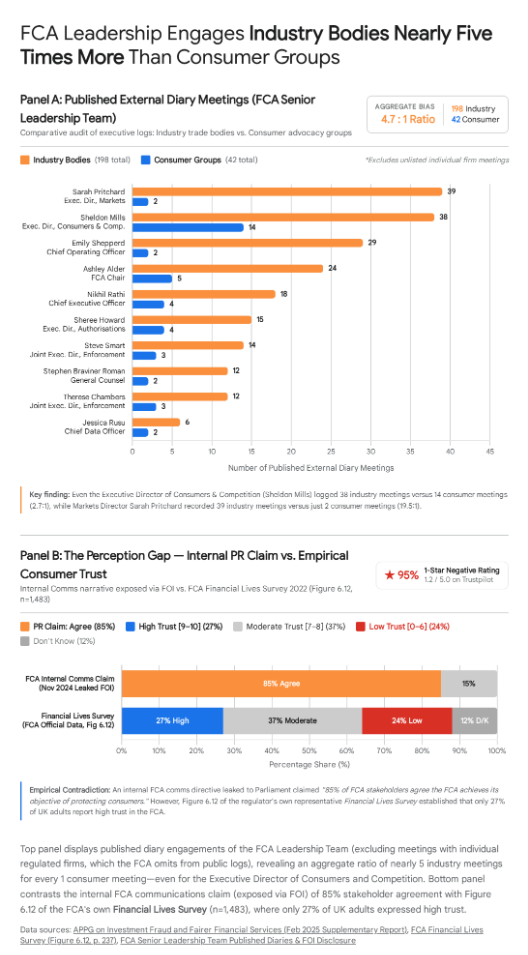
Following the publication of the APPG on Investment Fraud and Fairer Financial Services’ landmark 26 November 2024 report (compiling 174 testimonies), the APPG Secretariat sent two courteous emails (on 20 November and 26 November 2024) to FCA CEO Nikhil Rathi and Chair Ashley Alder inviting them to attend Parliamentary briefings or meet as a “critical friend”1. Neither Rathi nor Alder ever replied1. Instead, Rathi appeared on BBC Moneybox to dismiss the testimonies as “historic” and claim “we’re a very different organisation,” while FCA Board minutes of 28 November 2024 dismissed the report as lacking “a balanced reflection of the organisation” and focused on “strategic communications”1. In its 3 February 2025 Supplementary Report, the APPG—aided by an FOIA disclosure obtained by former FCA employee Ahmet Latif—exposed how the FCA leadership sought to deflect parliamentary scrutiny using misleading internal statistics1.
An internal email sent on 26 November 2024 by senior FCA communications official Ruth Wharram claimed that “85% of FCA stakeholders (including consumer groups and politicians) agree the FCA achieves its objective of protecting consumers”1. The APPG demonstrated that this 85% claim directly contradicted Figure 6.12 of the FCA’s own Financial Lives Survey 2022 (p. 237), which showed that among UK adults aware of the regulator, only 27% had high trust (scores 9–10) in the FCA to protect their best interests as consumers, 37% had moderate trust (7–8), 24% had low trust (0–6), and 12% did not know1. Furthermore, the APPG revealed that the FCA keeps its annual stakeholder perception surveys conducted by BritainThinks (now Thinks Insight & Strategy) stamped “Private and Confidential” and restricts publication to internal staff1.
Meanwhile, on public review platform Trustpilot, 95% of reviewers awarded the FCA the lowest possible rating of 1 out of 5 stars (an overall score of 1.2 / “Bad”)33. To test whether the FCA genuinely engages with consumer representatives, the APPG audited the published official diary engagements of all ten members of the FCA’s Senior Leadership Team1. Even though the FCA excludes all meetings with individual regulated firms from its published logs—meaning industry contact is vastly under-reported—the diary audit revealed that for every one meeting held with a consumer-oriented group, the FCA leadership held nearly five meetings with industry trade bodies and lobbyists1.
Structural Root Causes: Corporate Colonisation, the Revolving Door, and Toxic Internal Culture
The empirical patterns documented across independent inquiries are not isolated operational accidents; they are the predictable output of three intersecting structural zones within the UK regulatory architecture: the two-way Revolving Door, the internal 20-Cell Matrix of Regulatory Self-Conflict, and an outer Accountability Shield composed of statutory immunity, Section 348 secrecy, asymmetric Maxwellisation, and law- enforcement MoUs1.
Corporate Colonisation and the Two-Way Revolving Door
In his landmark 2015 High Pay Centre study, The Revolving Door and the Corporate Colonisation of UK Politics, Professor Stephen Wilks (former member of the Competition Commission and Member of the Competition Appeal Tribunal) demonstrated that a corporate elite of approximately 5,000 individuals— comprising FTSE 100 executives, major clearing banks, Big-4 accounting partnerships, and City law firms— has systematically colonised the British state, specifically capturing HM Treasury, the FCA, and the FRC1. Rather than merely lobbying government from the outside, large financial corporations have “acquired” the regulatory apparatus from within through a bidirectional traffic of personnel7.
On the “revolving-in” side, an OECD study cited by both Professor Wilks and Dr Costanza Russo established that out of 36 FSA Board members appointed from January 2000 onwards, 26 (72%) had board or senior-level ties to the banking and finance industry either before or after their regulatory tenure, and 9 continued to hold active appointments in financial corporations while sitting on the FSA Board1. Across Whitehall and regulatory agencies, corporate Non-Executive Directors (NEDs) and private-sector secondees from KPMG, PwC, Deloitte, EY, HSBC, and Goldman Sachs have been embedded into governance boards and policy teams7. Movement out of the regulator into regulated firms and their professional advisers is equally pervasive1.
For example, FSA Head of Enforcement Margaret Cole resigned in March 2012 to become in-house Head of Legal Services at PwC—auditor to major banks investigated by the FSA, such as JPMorgan—without her appointment even being reviewed by the Advisory Committee on Business Appointments (ACOBA)1. Similarly, senior FSA and FCA executives and lawyers—including Clive Adamson, Jane Attwood, Andrew Brodie, and Andy Clark—routinely revolve into the compliance, risk, and legal departments of the very banks they supervised1. As Professor Wilks documented, ACOBA is an entirely non-statutory, self-regulating, “toothless” body drawn from the very elite tribes it purports to police, which approved 1,020 business appointments for 600 ministers and top civil servants between 2000 and 2014 while leaving Director and Deputy Director grades completely unmonitored7.
Ethical Deficits and Failure to Resolve Conflicts of Interest
In her February 2016 ethical audit for the Committee on Standards in Public Life (CSPL), The Ethics of Banking and Financial Regulatory Authorities, Dr Costanza Russo (Co-Director of the Institute for Regulation and Ethics at Queen Mary University of London) evaluated the FCA against the Seven Nolan Principles of Public Life1. Dr Russo found that, unlike the Bank of England, the FCA’s corporate narrative, website, Handbook, and job specifications lacked a clear public-interest value statement, and its “Principles of Good Regulation” omitted any duty for the regulator itself to act with integrity1. Crucially, Dr Russo established that the FCA imposes no “revolving-in” or “revolving-out” prohibitions beyond basic statutory minima and notice- period gardening leave1.
Contrary to the Nolan Principle of Integrity—which requires holders of public office to resolve conflicts of interest rather than merely record them—the FCA’s Code of Conduct relies on internal registration and fails to require incoming senior executives or external board members to divest deferred remuneration, stock options, or pension schemes tied to regulated financial institutions1. Furthermore, because the FCA is funded directly by levies on regulated firms rather than through general taxation, its leadership explicitly frames its mission in terms of delivering “value for money” to regulated firms as fee- paying customers1.
Statutory Immunity and the 20-Cell Matrix of Self-Conflict
Under Schedule 1ZA, Paragraph 25 of FSMA 2000 (as amended by the Financial Services Act 2012), the FCA and its staff enjoy broad statutory immunity from civil liability in damages unless a claimant can clear the virtually insurmountable threshold of proving “bad faith” or a breach of the Human Rights Act 19981. While originally envisaged under Basel Core Principles to prevent deep-pocketed banks from paralysing supervisors with defensive litigation, applying this statutory immunity against ordinary retail consumers and SMEs removes all financial jeopardy when the FCA’s gross supervisory negligence causes hundreds of millions of pounds in retail losses1. Simultaneously, the FCA is paralysed by an internal “20-Cell Matrix” of inherent self-conflict1.
The regulator is tasked with four competing operational and secondary objectives— consumer protection, market integrity, promoting effective competition, and (added by the Financial Services and Markets Act 2023) facilitating the international competitiveness and growth of the UK economy—across five operational functions: policymaking, authorisation, conduct supervision, prudential supervision (for ~48,500 solo-regulated firms), and enforcement1.
| Statutory Objective \ Operational Function | 1. Policymakin g | 2. Authorisatio n | 3. Conduct Supervision | 4. Prudential Supervision (~48,500 Firms) | 5. Enforcemen t |
| A. Consumer Protection | Diluted by industry lobbying & cost-benefit hurdles. 1 | Pressure for rapid approvals creates “halo effect” | Reluctance to intervene in “individual cases” or | Ordering full consumer redress threatens firm | Enforcement exposes prior failures by Authorisatio |
| scams (LC&F, Premier FX). 1 | check APRs (SafetyNet). 1 | solvency and triggers FSCS levies. 1 | n and Supervision teams. 1 | ||
| B. Market Integrity | Perimeter carved out to exclude mini- bonds & commercial lending. 1 | Corrupt or insolvent controllers approved (Tiuta, Lendy, Collateral). 1 | Reliance on firm self- attestations and conflicted S.166 Skilled Persons. 1 | Forbearance toward technical insolvency at major clearing banks (HBOS). 1 | Fines prioritised over restitution to feed HM Treasury Consolidated Fund. 1 |
| C. Effective Competition | Rules favour large incumbents over small IFAs and challenger firms. 1 | Innovation sandboxes and fast- tracks exploited by high-risk P2P operators. 1 | Aggressive spot-checks weaponised against small IFAs while banks self- regulate. 1 | Consolidatio n and asset sales to unregulated vulture funds (Mortgage Prisoners). 1 | 99% of closed cases target corporate entities; senior bank executives shielded. 1 |
| D. International Competitivenes s & Growth (FSMA 2023) | Deregulatory pressure weakens retail protections and disclosure rules. 2 | Lowering entry barriers to attract capital undermines gatekeeping rigour. 2 | “Rebalancin g risk” (2025–2030 Strategy) deprioritises granular file audits. 4 | Wholesale bank stability and City reputation trump retail/SME remediation. 2 | Fear that prosecuting systemic banks or executives will deter City investment. 2 |
This 4×5 matrix generates acute institutional paralysis across divisions1. Aggressive action by the Enforcement division against a fraudulent firm (such as LC&F, Connaught, or Lendy) inherently exposes the FCA’s own Authorisation and Supervision divisions for having approved and failed to police the firm1. Equally, ordering multi-billion-pound consumer or SME redress threatens the prudential solvency of firms and the “competitiveness” of the City1. As FCA whistleblowers disclosed to Bank Confidential C.I.C., when Jonathan Davidson (Head of Retail Bank Supervision) sought to compel banks to reimburse customers for billions of pounds in mis-sold structured products, he was blocked by Megan Butler (Head of Wholesale Bank
Supervision), who was backed by then-CEO Andrew Bailey to prevent any compensation scheme4. Similarly, under the Financial Services Act 2012, the Bank of England’s Financial Policy Committee (FPC) and the PRA hold veto and direction powers over the FCA whenever “financial stability” is invoked2.
Defective Internal Culture, “Bleaching,” and the Failed £317 Million
Transformation Programme
Evidence from current and former FCA employees (Question Set G) reveals an authoritarian, risk-averse, and hierarchical internal culture summarised by the insider maxim: “I have done nothing therefore I have done nothing wrong”1. Front-line supervisors and experienced industry specialists who identify money- laundering failures, unworkable policies, or systemic misconduct by large groups are scolded by senior managers (e.g., “what’s the point of doing this if it ends up putting the company out of business!”), labelled as “troublemakers” or the “awkward squad,” isolated from their teams, denied bonuses and pay rises, or managed out1. Senior directors surround themselves with “nodding donkeys” and “career regulators” who lack basic financial literacy1.
Insiders also testified to systemic racial discrimination, including a “bleaching” process in promotions to senior management ranks and persistent pay and bonus gaps for Black, Asian, and Minority Ethnic (BAME) staff performing identical roles1. Following the excoriating Gloster and Parker reviews in December 2020, CEO Nikhil Rathi launched an expensive “Transformation Programme”—initially placing it under the leadership of Megan Butler, the very executive criticised in the Gloster Report for presiding over the LC&F and Connaught failures1. By cutting specialist pay bands, imposing appraisal quotas, and refusing to recognise the Unite trade union, Rathi’s programme triggered the first staff strike in the history of the FSA/FCA in 2022 and left over 730 critical vacancies—up to 25% of headcount in key supervision departments1.
Recent Reports, Judicial Rebukes, and Empirical Disclosures on FCA Malfeasance (2024–2026)
Subsequent parliamentary inquiries, National Audit Office (NAO) audits, appellate court judgments, and statutory disclosures published between 2024 and late 2026 confirm that the FCA’s structural and cultural dysfunctions have intensified rather than abated1.
House of Lords Financial Services Regulation Committee Reports and NAO Audit (2025–2026)
Parliamentary scrutiny in 2025 and 2026 has repeatedly exposed the FCA’s procedural overreach and cultural stagnation1. Following the FCA’s controversial consultation (CP24/2) proposing to publicly name regulated firms at the outset of enforcement investigations before any findings of fact or due process had occurred, the House of Lords Financial Services Regulation Committee published a blistering report on 6 February 2025 titled Naming and shaming: how not to regulate (HL Paper 76)1.
The Committee condemned the FCA’s lack of stakeholder engagement as unacceptable, found its justification unconvincing given its existing statutory powers, declared the FCA’s claim that its proposals matched international regulators to be misleading, and criticised the absence of a cost-benefit analysis1. By June 2025, and in follow-up correspondence with Committee Chair Baroness Noakes in June 2026, the FCA was forced into a major retreat on its “naming and shaming” proposals1. In a second major report published on 13 June 2025, Growing pains: clarity and culture change required, the Lords Committee warned that a deeply entrenched culture of risk aversion, bureaucracy, and box-ticking inside both the FCA and the PRA continues to undermine their regulatory effectiveness as well as their secondary competitiveness and growth objective1.
These parliamentary findings were reinforced by the National Audit Office’s (NAO) value-for-money investigation into the FCA, Financial services regulation: Adapting to change1. The NAO established that while the regulator spent £317 million on its change and transformation programme between 2020–21 and 2022– 23 and expanded headcount by 16%, its operational changes were “both too slow and too disruptive”1. The NAO highlighted severe enforcement delays—noting that although crypto-asset anti-money laundering (AML) rules took effect in January 2020, the FCA failed to initiate enforcement action until more than three years later in 2023—alongside persistent specialist skills shortages in financial crime and crypto supervision, and complex performance reporting that prevents HM Treasury and external stakeholders from judging the regulator’s effectiveness1.
Complementing the NAO’s conclusions, the APPG on Investment Fraud and Fairer Financial Services published a comprehensive structural report in March 2026 titled Why Our Financial Conduct Regulation Needs Reforming, demonstrating that Parliament has delegated excessive discretion to the FCA under vague statutory terms such as “appropriate,” turning fairness into an unaccountable administrative standard while deregulation agendas under the guise of “growth” and “rebalancing risk” (the centrepiece of the FCA’s 2025–2030 strategy) threaten to worsen mis-selling, scams, and public distrust34.
Upper Tribunal and Court of Appeal Rebukes of FCA Enforcement Conduct (2024–
2026)
Between 2024 and 2026, the judiciary has repeatedly rebuked the FCA for investigative incompetence, disclosure failures, and adversarial misconduct1. After the Upper Tribunal threw out the FCA’s enforcement case against former Julius Baer executives Thomas Seiler and Louise Whitestone—finding that the FCA’s “confidence was misplaced” and exposing “significant gaps and flaws in the investigation,” including systemic document disclosure failures and the FCA’s unreasonable refusal to call material witnesses—the FCA appealed the Tribunal’s adverse costs order1. On 30 July 2024, in Seiler, Whitestone & Raitzin v FCA, the Court of Appeal dismissed the FCA’s appeal, ruling that the FCA is not an ordinary commercial litigant entitled to play adversarial games, but a public body engaged in a joint enterprise in the public interest1. The judicial rebuke forced the FCA on 11 November 2024 to publish an outcome review overhauling its enforcement disclosure processes and staff training1.
In the retail mass-redress sphere, following years of regulatory vacillation over discretionary commission arrangements (DCAs) in motor finance, the FCA’s proposed mass redress scheme was partially suspended on 2 July 2026 following an Upper Tribunal decision amidst legal challenges brought simultaneously by consumer advocates (Consumer Voice) and major lenders (Volkswagen Financial Services, Mercedes-Benz Financial Services, and Crédit Agricole Auto Finance), pushing full hearings into December 2026 and February 20271. Furthermore, the Upper Tribunal’s judgment on 10 September 2026 in Robin Crispin Odey v FCA (UT-2025-000021)—referenced by Nikhil Rathi before the Treasury Committee on 13 October 2026—demonstrated the protracted five-year timeline between underlying governance events (2021–2022) and judicial resolution when the FCA’s RDC attempts to prosecute individual governance and integrity breaches1.
July 2026 Statutory Disclosures: Complaints Collapse, Enforcement Skew, and Whistleblowing Backlogs
Three statutory disclosures published in July 2026 provide definitive quantitative evidence of the FCA’s ongoing operational trajectory1. First, in the Financial Regulators Complaints Commissioner (FRCC) Annual Report 2025–2026 (published 15 July 2026), Commissioner Rachel Kent (in post since August 2023) revealed that the proportion of complaints upheld by the FCA concluded in 2025/26 plummeted to 11.4% (120 cases), down from 41.4% (812 cases) in 2024/251. Commissioner Kent highlighted ongoing systemic tensions regarding the FCA’s refusal to offer meaningful financial compensation when supervisory failures occur, persistent delays and indefinite “deferrals” in complex and group complaints, and widespread public frustration over the FCA’s hands-off oversight of the FOS1.
Notably, in a group complaint brought by 51 investors in the collapsed P2P platform The House Crowd (THC), Commissioner Kent found that the FCA had rigidly and unlawfully applied the 12-month time bar under Paragraph 2.4 of the Scheme without demonstrating that complainants had actual knowledge of the regulatory failures, forcing the FCA to lift the time bar and open a full investigation16. Second, according to the FCA’s Enforcement Data 2025/26 (published 9 July 2026), fewer than 1% of enforcement cases opened in 2025/26 were against individuals, and of all enforcement cases closed in 2025/26, 99% related to firms and only 1% related to individuals1. This confirms the APPG and Violation Tracker UK finding that the FCA continues to levy headline fines against corporate shareholders (£129 million in 2025/26 across 30 Final Notices, following penalties such as £29 million against Starling Bank and £16 million against Metro Bank in 2024/25) while leaving culpable senior executives virtually untouched under the Senior Managers and Certification Regime (SMCR)1. Third, in its Prescribed Persons Annual Report 2025/26 (published 9 July 2026), the FCA reported receiving 1,375 new whistleblowing reports containing 4,375 separate allegations in 2025/26 (a 22% increase from 1,131 reports in 2024/25, with Q1 2026 jumping 26% year-on-year), yet closed only 1,252 cases (511 fewer than the prior year)1. Of the closed cases, 58% resulted in no direct action, and while the FCA claimed 42% led to “direct action,” the vast majority consisted merely of routine information requests or firm self-attestations rather than enforcement, Section 166 Skilled Person reports, or permission restrictions, which accounted for just 59 cases (~4.7% of closed reports)1.
Structural Reform Blueprint: Redesigning the UK Financial Regulatory Architecture
Because the FSA and FCA have proven impervious to self-reform across more than two decades of independent reviews, the APPG’s independent Recommendations Panel (comprising legal academics, former MPs, consumer advocates, and financial ethicists), alongside submissions to the Treasury Select Committee and the 2025–2026 Protection for Whistleblowing legislative proposals, sets out a comprehensive seven-pillar reform architecture to dismantle regulatory capture and restore democratic accountability1:
| Reform Pillar | Statutory & Institutional Mechanism | Specific Pathologies Resolved |
| 1. Financial Regulators’ Supervisory Council (FRSC) (“Twin Peaks 2.0”) | Enact primary legislation establishing an independent supervisory council (modelled on an enhanced version of Australia’s Financial Regulator Assessment Authority) funded by a 0.5% levy on the FCA’s annual budget and composed strictly of non-industry consumer and whistleblower representatives. 1 | Ends FCA self-assessment (“marking its own homework”); empowers the FRSC to jointly appoint/dismiss the FCA Chair and CEO alongside HM Treasury, appoint consumer NEDs and the heads of the FOS, FSCS, and FRCC, and commission truly independent statutory reviews with unredacted publication. 1 |
| 2. Abolish Statutory Immunity for Consumer & SME Claims | Amend Schedule 1ZA of FSMA 2000 / Financial Services Act 2012 to strip the FCA of statutory immunity from civil liability in claims brought by retail consumers and non-regulated SMEs, while retaining immunity against defensive lawsuits by regulated financial institutions. 1 | Restores natural justice and creates direct financial accountability for gross supervisory negligence (such as re-authorising insolvent firms or ignoring police warnings). 1 |
| 3. Civilly Actionable Duty of Care & Executive Personal Guarantees | Replace the administrative Consumer Duty with a statutory Duty of Care backed by a Private Right of Action in tort for consumers and SMEs, and require senior executives and controllers of authorised firms to sign Personal Guarantees as a condition of licensing. 1 | Pierces the corporate veil so senior bankers and controllers—rather than passive shareholders or the FSCS—are personally and financially liable first in the event of firm failure caused by recklessness or fraud. 1 |
| 4. Independent Office of the Whistleblower & Criminal Penalties | Enact the Protection for Whistleblowing Bill to remove whistleblowing intake and protection from the conflicted FCA and transfer it to a dedicated, independent Office of the Whistleblower (augmenting the Day-One protections of the Employment Rights Act 2025). 1 | Establishes civil and criminal offences for retaliation or breaching whistleblower anonymity, mandates independent legal/D&O funding for whistleblowers, and ends the FCA’s practice of tipping off firms or delegating probes to accused executives. 1 |
| 5. Statutory Revolving-Door Bans & State- Insulated Funding | Abolish the non-statutory ACOBA regime and enact a statutory 3-to-5 year cooling-off ban (enforced by a statutory Conflicts of Interest and Ethics Commissioner reporting to Parliament, per the Canadian and South Korean models) barring FCA staff from joining regulated firms or Big-4/legal advisers, and replace direct industry levies with public-purse funding recouped via a hypothecated industry tax. 1 | Eliminates corporate colonisation, forces divestment of financial conflicts upon joining the regulator, and stops the FCA from treating regulated firms as fee-paying “customers”. 1 |
| 6. Mandatory Regulatory Risk Audits & Perimeter Reform | Require statutory financial auditors of FCA-licensed firms to audit and report on regulatory compliance liabilities (such as mis-selling exposure and representative APR accuracy), upload all standard financial contracts to a central portal, abolish or impose 100% strict principal liability on the Appointed Representative (AR) regime, and ban authorised firms | Ends the audit loophole whereby 30+ payday lenders, HBOS, and Ulster Bank received clean audit opinions despite massive hidden liabilities or fraud, and closes the LC&F mini-bond perimeter gap. 1 |
| from using the FCA “halo effect” to market unregulated products. 1 | ||
| 7. Royal Commission & Dedicated SME / Consumer Regulator | Convene a Royal Commission (mirroring the 2017–2019 Australian Banking Royal Commission) to strip out the FCA’s 20- Cell Matrix conflicts by transferring prudential supervision of all ~48,500 firms to the PRA, competition to the CMA, and “competitiveness and growth” to the Department for Business and Trade, while establishing a dedicated SME and Complex Consumer Regulator (akin to the US CFPB) with an independent compliance audit team. 1 | Resolves the intractable conflict between promoting City growth/bank stability and enforcing consumer/SME restitution, while providing a dedicated tribunal and forensic audit unit to resolve historical banking frauds. 1 |
Works cited
1. Anthony Stansfeld on HBOS and FCA.docx
2. FINAL-Call-for-Evidence-Report-PUBLIC-1.pdf
3. THE FCA EXPOSED Documentary 29th Oct 2026.pdf
4. Hansard on FCA.docx
5. a-review-of-maxwellisation-24-11-16.pdf
6. The Simon Andriesz Story; and the Role of the Financial Conduct, https://transparencytaskforce.org/the-simon-andriesz-story-and-the-role-of-the-financial- conduct-authority/
7. FINAL_REVOLVING_DOOR.pdf
8. The Cranston Review_v2.pdf
9. Report on the Call for Evidence about The Financial Conduct Authority, https://www.appgifffs.org/wp-content/uploads/2024/11/FINAL-Call-for-Evidence-Report- PUBLIC-1.pdf
10. Response to request for clarification.pdf
11. The Unacceptable State of Affairs regarding the Dame Linda Dobbs, https://transparencytaskforce.org/wp-content/uploads/2025/02/The-Unacceptable-State-of- Affairs-regarding-the-Dame-Linda-Dobbs-Review-1.pdf
12. Treasury Committee, https://committees.parliament.uk/oralevidence/1636/pdf/
13. Report of the Independent Review into the FSA and FCA’s handling, https://www.fca.org.uk/publication/corporate/connaught-independent-review-response.pdf
14. Independent review of the Connaught Income Fund Series 1 | FCA, https://www.fca.org.uk/transparency/independent-review-connaught-income-fund-series-1
15. UK’s financial regulator rapped following LCF collapse, https://signaturelitigation.com/uks-
financial-regulator-rapped-following-lcf-collapse-paul-brehony-abdulali-jiwaji-and-johnny- shearman/
16. Reviewing how the financial services regulators consider complaints, https://frccommissioner.org.uk/wp-content/uploads/2025-2026-Issued-15-July-2026.pdf
17. FCA Whistleblowing Training: Speak-Up Culture – 5Mins.ai, https://www.5mins.ai/resources/blog/fca-whistleblowing-training-speak-up-culture
18. E. Christopher Riley without contact details, https://www.appgifffs.org/wp- content/uploads/2022/02/E.-Christopher-Riley-without-contact-details-1.pdf
19. 2025 07 16 – STAMP Iain Clifford – APPROVED Judgment, https://www.judiciary.uk/wp-
content/uploads/2025/07/2025-07-16-STAMP-Iain-Clifford-APPROVED-Judgment.pdf
20. UK regulator FCA to publish whistleblower review in early 2027, https://www.globalbankingandfinance.com/uk-regulator-fca-publish-whistleblower-review- early-2027/
21. When Speaking Up Costs You Your Life Back: Lessons from Simon, https://academyoflifeplanning.blog/2026/10/03/when-speaking-up-costs-you-your-life-back- lessons-from-simon-andrieszs-case/
22. UK regulator FCA to investigate how it handled Epstein, https://www.theguardian.com/business/2026/oct/06/uk-regulator-epstein-whistleblower
23. FCA Under Fire Over Whistleblower Treatment and Regulatory Trust, https://fincrimecentral.com/fca-whistleblower-treatment-2026-review-crisis/
24. Oral evidence – 13 Oct 2026 – UK Parliament Committees, https://committees.parliament.uk/oralevidence/18118/html
25. MPs quiz FCA on transparency, tech and Treasury relations, https://www.compliancecorylated.com/news/mps-quiz-fca-on-transparency-tech-and- treasury-relations/
26. Looking at how we interact with whistleblowers – FCA, https://www.fca.org.uk/news/blogs/looking-how-we-interact-whistleblowers
27. Bank of Englandʼs former chief people officer to investigate FCAʼs, https://www.compliancecorylated.com/news/bank-of-england%CA%BCs-former-chief- people-officer-to-investigate-fca%CA%BCs-interactions-with-whistleblower/
28. FCA Faces Calls To Replace Andriesz Whistleblower Probe: Joanna Chatterton and Sebastian
Sayer comment for Law360, https://www.foxwilliams.com/2026/10/12/fca-faces-calls-to- replace-andriesz-whistleblower-probe-joanna-chatterton-and-sebastian-sayer-comment-for- law360/
29. FCA Faces Calls To Replace Andriesz Whistleblower Probe, https://www.mrllp.com/news-
item/fca-faces-calls-to-replace-andriesz-whistleblower-probe/
30. Ethics_of_Banking_and_Financial_Regulatory_Authorities_by_Dr_Costanza_Russo.pdf
31. Report of the Independent Investigation into the Financial Conduct, https://assets.publishing.service.gov.uk/media/5fda3d698fa8f54d60878b2f/Gloster_Report_ FINAL.pdf
32. Supplementary-Report-about-the-FCA-by-the-APPGIFFFS-as-at-29th-January-
2025.docx.pdf
33. Why our Financial Conduct Regulation Needs Reforming, https://www.appgifffs.org/wp-
content/uploads/2026/03/why-our-financial-conduct-regulation-needs-reforming.docx.pdf
34. Financial Conduct Authority Annual report and accounts 2025/26, https://www.fca.org.uk/publication/annual-reports/annual-report-2025-26.pdf
35. Annual Report and Accounts 2024-2025 – FCA, https://www.fca.org.uk/publication/annual-